

Ecommerce Solutions Guide 2026 | Complete Online Store & eCommerce Business Guide

Introduction to Ecommerce Solutions


7
The digital economy has transformed the way people buy and sell products. Today, businesses of all sizes rely on Ecommerce Solutions to establish an online presence, reach global customers, streamline operations, and increase revenue. From small startups selling handmade products to multinational brands managing millions of daily transactions, ecommerce has become one of the most important industries in the modern world.
Ecommerce Solutions encompass the technologies, platforms, tools, and services that enable businesses to create, manage, and grow online stores. These solutions include everything from eCommerce websites, online store builders, shopping carts, payment gateways, and inventory management systems to customer relationship management (CRM) software, shipping integrations, digital marketing tools, and AI-powered automation.
Unlike traditional retail businesses that are limited by physical locations and operating hours, ecommerce businesses operate 24/7 and can serve customers worldwide. Modern Ecommerce Solutions also help businesses analyze customer behavior, personalize shopping experiences, automate repetitive tasks, and improve overall efficiency.
Whether you’re launching your first online business, migrating from a physical store to an ecommerce platform, or scaling an existing online store, understanding the fundamentals of Ecommerce Solutions is the first step toward long-term success.
What Are Ecommerce Solutions?


6
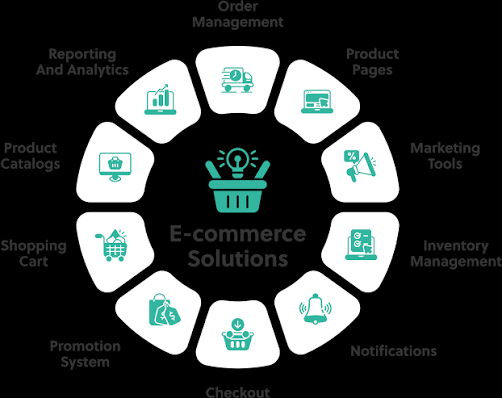
Ecommerce Solutions refer to the complete ecosystem of software, technologies, and services used to build, operate, manage, and optimize an online business. Rather than being a single product, ecommerce solutions combine multiple components that work together to provide a seamless shopping experience.
A complete ecommerce solution typically includes:
- Online Store Builder
- Product Catalog Management
- Shopping Cart System
- Secure Checkout
- Payment Gateway Integration
- Inventory Management
- Order Processing
- Customer Accounts
- Shipping & Logistics
- Marketing Automation
- Analytics & Reporting
- Security & Fraud Protection
For example, when a customer visits an online clothing store, browses products, adds items to the cart, pays securely, and receives order updates, dozens of ecommerce systems work together behind the scenes to complete the transaction.
Modern Ecommerce Solutions are designed to simplify these processes while allowing businesses to focus on growth, customer satisfaction, and innovation.
Why Ecommerce Solutions Are Important


6
The rapid growth of internet access, smartphones, and digital payment systems has made ecommerce an essential part of the global economy. Consumers increasingly expect convenient, fast, and secure online shopping experiences, making Ecommerce Solutions indispensable for businesses.
Key Benefits
- Sell products 24/7
- Reach customers globally
- Lower operational costs
- Automate business processes
- Improve customer experience
- Scale quickly
- Track business performance
- Offer multiple payment methods
- Personalize shopping experiences
- Increase sales opportunities
Businesses that embrace ecommerce gain a competitive advantage by meeting customers where they already spend much of their time—online.
Evolution of Ecommerce


5
Ecommerce has evolved dramatically over the past three decades.
Early Years (1990s)
The introduction of the World Wide Web enabled businesses to sell products online. Early ecommerce websites were simple, offering limited product catalogs and basic payment options.
Growth Phase (2000–2010)
Broadband internet, secure payment systems, and improved website technologies made online shopping more reliable. Businesses began investing in professional ecommerce platforms.
Mobile Commerce Era (2010–2020)
The widespread adoption of smartphones shifted consumer behavior toward mobile shopping. Responsive website design and dedicated shopping apps became essential.
AI & Automation Era (2020–Present)
Modern Ecommerce Solutions leverage Artificial Intelligence, automation, machine learning, chatbots, predictive analytics, and personalized recommendations to enhance customer experiences and improve operational efficiency.
Types of Ecommerce Business Models


4
Understanding ecommerce business models helps businesses choose the right strategy.
B2B (Business-to-Business)
Businesses sell products or services directly to other businesses.
Examples:
- Wholesale suppliers
- Manufacturing companies
- SaaS providers
- Office equipment suppliers
Advantages
- Higher order values
- Long-term customer relationships
- Predictable revenue
B2C (Business-to-Consumer)
The most common ecommerce model where businesses sell directly to consumers.
Examples include:
- Fashion stores
- Electronics stores
- Grocery delivery
- Beauty products
C2C (Consumer-to-Consumer)
Individuals sell products directly to other consumers.
Examples:
- Online marketplaces
- Used goods platforms
- Auction websites
C2B (Consumer-to-Business)
Consumers provide products or services to businesses.
Examples:
- Freelancers
- Influencers
- Stock photographers
- Consultants
D2C (Direct-to-Consumer)
Manufacturers bypass distributors and sell directly to customers through their own ecommerce websites.
Benefits include:
- Higher profit margins
- Better customer relationships
- Greater control over branding
Core Components of Ecommerce Solutions


6
A successful ecommerce business relies on multiple integrated components.
1. Ecommerce Website
The central platform where customers browse products and make purchases.
2. Product Catalog
Displays products with descriptions, pricing, specifications, and images.
3. Shopping Cart
Allows customers to add, remove, and modify products before checkout.
4. Checkout System
Provides a secure and user-friendly purchasing experience.
5. Payment Gateway
Processes online payments using methods such as credit cards, digital wallets, and UPI.
6. Inventory Management
Tracks product availability, stock levels, and warehouse operations.
7. Order Management
Handles order processing, invoicing, shipping, and fulfillment.
8. Customer Accounts
Allows customers to manage profiles, orders, wishlists, and addresses.
9. Shipping Integration
Connects ecommerce stores with logistics providers for shipping and tracking.
10. Analytics Dashboard
Provides insights into sales, customer behavior, traffic, and conversions.
Advantages of Ecommerce Solutions


5
Businesses invest in Ecommerce Solutions because they offer numerous advantages.
Business Benefits
- Lower startup costs
- Global market access
- 24/7 availability
- Faster business expansion
- Automated operations
- Improved customer insights
- Flexible pricing strategies
- Better inventory control
- Data-driven decision-making
- Enhanced scalability
Customer Benefits
- Shop anytime
- Wider product selection
- Secure online payments
- Easy product comparisons
- Faster delivery options
- Personalized recommendations
- Convenient returns
- Mobile shopping
Challenges of Ecommerce Solutions


6
Despite its advantages, ecommerce also presents several challenges.
Common Challenges
- High competition
- Cybersecurity threats
- Cart abandonment
- Shipping delays
- Inventory management issues
- Payment fraud
- Website downtime
- Customer acquisition costs
- Product returns
- Technology upgrades
Recognizing these challenges early helps businesses implement effective strategies to overcome them.
Essential Features of Modern Ecommerce Solutions


6
A modern ecommerce platform should include:
- Mobile-friendly design
- Fast loading speeds
- Secure checkout
- SSL encryption
- Multiple payment options
- Product search
- Customer reviews
- Wishlist functionality
- Order tracking
- Marketing tools
- SEO optimization
- AI recommendations
- Analytics dashboard
- Inventory management
- Multi-language support
- Multi-currency support
These features enhance user experience and improve conversion rates.
Ecommerce Solutions Comparison Table
| Feature | Basic Store | Advanced Ecommerce Solution |
|---|---|---|
| Product Management | Limited | Advanced |
| Payment Options | Few | Multiple |
| Inventory Tracking | Basic | Real-Time |
| SEO Tools | Limited | Comprehensive |
| Analytics | Basic | Advanced |
| Security | Standard | Enterprise-Level |
| Automation | Minimal | Extensive |
| Scalability | Moderate | High |
| Mobile Optimization | Optional | Essential |
| AI Features | No | Yes |
Best Practices for Ecommerce Solutions
- Choose a scalable ecommerce platform.
- Optimize website speed and Core Web Vitals.
- Use high-quality product images.
- Write SEO-friendly product descriptions.
- Offer secure payment options.
- Enable SSL encryption.
- Simplify the checkout process.
- Monitor inventory in real time.
- Use analytics to improve performance.
- Provide excellent customer support.
Common Mistakes to Avoid
- Choosing the wrong ecommerce platform.
- Ignoring mobile users.
- Using poor-quality product images.
- Complicated checkout processes.
- Weak website security.
- Not optimizing for search engines.
- Slow website loading speeds.
- Poor inventory management.
- Lack of customer support.
- Ignoring customer feedback.
Key Takeaways
- Ecommerce Solutions provide the tools and technologies needed to build, manage, and grow online businesses.
- Understanding different business models—such as B2B, B2C, C2C, C2B, and D2C—helps businesses choose the right approach.
- A successful ecommerce store depends on key components like secure checkout, inventory management, payment gateways, analytics, and customer support.
- Modern ecommerce platforms emphasize automation, mobile optimization, AI-driven personalization, and strong security.
- Investing in scalable and user-friendly ecommerce solutions lays the foundation for long-term online business success.
Choosing the Right Ecommerce Platform


7
Selecting the right platform is one of the most important decisions when building an online business. The platform serves as the foundation of your website and influences everything from website speed and SEO to customer experience, scalability, and long-term growth.
Modern Ecommerce Solutions offer a wide range of platforms designed for beginners, small businesses, enterprises, and developers. Some platforms are fully managed (SaaS), while others provide complete customization through self-hosted solutions.
The best platform depends on your budget, technical expertise, product catalog, expected traffic, and business goals.
What is an Ecommerce Platform?


6
An Ecommerce Platform is software that enables businesses to create, manage, and operate an online store. It provides essential features such as:
- Product Management
- Shopping Cart
- Secure Checkout
- Payment Gateway Integration
- Inventory Management
- Customer Accounts
- Shipping Integration
- SEO Tools
- Marketing Features
- Analytics Dashboard
Instead of building an ecommerce website from scratch, businesses use these platforms to launch stores quickly and efficiently.
Types of Ecommerce Platforms


6
There are three primary categories of ecommerce platforms.
1. SaaS Ecommerce Platforms
Software-as-a-Service (SaaS) platforms are fully managed by the provider.
Advantages
- Easy setup
- Hosting included
- Automatic updates
- Built-in security
- Technical support
- Fast deployment
Best For
- Beginners
- Small businesses
- Startups
- Growing brands
Examples:
- Shopify
- BigCommerce
- Wix eCommerce
- Squarespace Commerce
2. Self-Hosted Ecommerce Platforms
Self-hosted platforms require users to purchase hosting and manage the software themselves.
Advantages
- Complete customization
- Full ownership
- Greater flexibility
- Better control
Best For
- Developers
- Agencies
- Large businesses
- Custom projects
Examples:
- WooCommerce
- Magento
- OpenCart
- PrestaShop
3. Headless Commerce
Headless Commerce separates the frontend (customer-facing website) from the backend (commerce engine) using APIs.
Advantages
- High performance
- Flexible design
- Faster development
- Omnichannel selling
- Better scalability
Best For
- Enterprise businesses
- Large brands
- Custom digital experiences
Shopify


6
Shopify is one of the world’s most popular SaaS ecommerce platforms.
Features
- Easy drag-and-drop builder
- Secure hosting
- Mobile-friendly themes
- App Store
- SEO tools
- Inventory management
- Multi-channel selling
- Built-in analytics
Pros
- Beginner-friendly
- Excellent performance
- Strong security
- Reliable hosting
- Large app ecosystem
Cons
- Monthly subscription
- Transaction fees (depending on payment provider)
- Limited backend customization
Best For
- Startups
- Small businesses
- Fashion brands
- D2C businesses
- Dropshipping stores
WooCommerce


6
WooCommerce is a free WordPress plugin that transforms WordPress into a powerful ecommerce platform.
Features
- Open-source
- Unlimited customization
- Thousands of plugins
- SEO-friendly
- Large community
- Flexible payment options
Pros
- Free core plugin
- Excellent SEO
- Full ownership
- Highly customizable
- Great for content marketing
Cons
- Requires hosting
- Requires maintenance
- Plugin compatibility issues
- Learning curve
Best For
- Bloggers
- WordPress users
- Medium businesses
- SEO-focused websites
Magento (Adobe Commerce)


5
Magento, now known as Adobe Commerce, is an enterprise-grade ecommerce solution.
Features
- Advanced customization
- Enterprise security
- Multi-store management
- AI-powered recommendations
- Advanced analytics
- Global commerce support
Pros
- Enterprise scalability
- Powerful features
- Flexible architecture
- High performance
Cons
- Expensive
- Complex setup
- Requires developers
- High maintenance
Best For
- Large enterprises
- International brands
- High-volume stores
BigCommerce


5
BigCommerce is a cloud-based ecommerce platform known for scalability and built-in features.
Features
- Multi-channel selling
- SEO optimization
- Product management
- Analytics
- Security
- API integrations
Pros
- No transaction fees
- Built-in features
- Good SEO
- Enterprise options
Cons
- Learning curve
- Premium plans are expensive
Best For
- Medium businesses
- Growing brands
- B2B companies
Wix eCommerce


6
Wix eCommerce offers a beginner-friendly website builder with ecommerce functionality.
Features
- Drag-and-drop editor
- Mobile optimization
- Payment gateways
- Marketing tools
- Templates
Best For
- Beginners
- Small businesses
- Local stores
- Personal brands
Squarespace Commerce


5
Squarespace Commerce is known for premium templates and visual design.
Features
- Beautiful templates
- Blogging
- Product management
- Digital products
- Marketing tools
Best For
- Designers
- Photographers
- Artists
- Creative businesses
OpenCart


6
OpenCart is a lightweight, open-source ecommerce platform.
Features
- Multi-store support
- Extensions
- Payment integrations
- Product management
Advantages
- Free
- Fast
- Lightweight
- Easy to customize
Limitations
- Smaller ecosystem
- Limited enterprise features
PrestaShop


5
PrestaShop is another popular open-source ecommerce solution.
Features
- Product management
- Marketing tools
- SEO features
- Multi-language support
- Multi-currency support
Best For
- International stores
- SMEs
- Growing businesses
Headless Commerce


6
Headless Commerce separates the frontend from the backend, allowing developers to build highly customized shopping experiences across websites, mobile apps, kiosks, and other digital channels.
Benefits
- Faster website performance
- Better scalability
- Flexible frontend design
- Omnichannel commerce
- API-first architecture
Challenges
- Higher development costs
- Requires technical expertise
- More complex maintenance
SaaS vs Self-Hosted Platforms
| Feature | SaaS | Self-Hosted |
|---|---|---|
| Hosting | Included | Separate |
| Maintenance | Provider | User |
| Security | Managed | Self-managed |
| Customization | Moderate | High |
| Cost | Subscription | Variable |
| Technical Skills | Low | Medium to High |
| Scalability | High | High |
| Updates | Automatic | Manual |
Platform Comparison Table
| Platform | Best For | Ease of Use | SEO | Customization | Scalability |
|---|---|---|---|---|---|
| Shopify | Beginners | ⭐⭐⭐⭐⭐ | ⭐⭐⭐⭐☆ | ⭐⭐⭐☆ | ⭐⭐⭐⭐⭐ |
| WooCommerce | WordPress | ⭐⭐⭐⭐☆ | ⭐⭐⭐⭐⭐ | ⭐⭐⭐⭐⭐ | ⭐⭐⭐⭐☆ |
| Magento | Enterprise | ⭐⭐☆☆☆ | ⭐⭐⭐⭐⭐ | ⭐⭐⭐⭐⭐ | ⭐⭐⭐⭐⭐ |
| BigCommerce | Growing Stores | ⭐⭐⭐⭐☆ | ⭐⭐⭐⭐☆ | ⭐⭐⭐⭐☆ | ⭐⭐⭐⭐⭐ |
| Wix | Small Stores | ⭐⭐⭐⭐⭐ | ⭐⭐⭐☆☆ | ⭐⭐⭐☆☆ | ⭐⭐⭐☆☆ |
| Squarespace | Creative Brands | ⭐⭐⭐⭐☆ | ⭐⭐⭐⭐☆ | ⭐⭐⭐☆☆ | ⭐⭐⭐☆☆ |
| OpenCart | Developers | ⭐⭐⭐☆☆ | ⭐⭐⭐⭐☆ | ⭐⭐⭐⭐☆ | ⭐⭐⭐⭐☆ |
| PrestaShop | SMEs | ⭐⭐⭐☆☆ | ⭐⭐⭐⭐☆ | ⭐⭐⭐⭐☆ | ⭐⭐⭐⭐☆ |
How to Choose the Best Ecommerce Platform
When evaluating platforms, consider:
- Business size
- Budget
- Product catalog size
- Technical expertise
- SEO capabilities
- Payment gateway support
- Mobile responsiveness
- Third-party integrations
- Security features
- Customer support
- Future scalability
Choosing the right platform early reduces migration costs and supports long-term growth.
Best Practices
- Select a platform that matches your business goals.
- Prioritize mobile-friendly design.
- Ensure the platform supports SEO best practices.
- Choose scalable hosting and infrastructure.
- Test payment gateways before launch.
- Keep plugins and themes updated.
- Optimize website speed and Core Web Vitals.
- Use SSL certificates for secure transactions.
- Back up your store regularly.
- Monitor analytics to improve conversions.
Common Mistakes
- Choosing based only on price.
- Ignoring scalability requirements.
- Overloading the site with unnecessary plugins.
- Not testing checkout functionality.
- Neglecting website security.
- Using poor-quality themes.
- Ignoring mobile optimization.
- Skipping regular updates.
- Failing to plan for future growth.
- Underestimating ongoing maintenance costs.
Key Takeaways
- Ecommerce platforms are the backbone of successful online stores.
- SaaS solutions like Shopify, BigCommerce, and Wix eCommerce offer simplicity and managed hosting.
- Self-hosted platforms such as WooCommerce, Magento, OpenCart, and PrestaShop provide greater flexibility and customization.
- Headless Commerce is an advanced option for businesses seeking highly customized, omnichannel experiences.
- Choosing the right platform depends on your business size, technical skills, budget, and long-term growth strategy.
Building a Professional Ecommerce Website


6
A successful online business begins with a well-designed website. Your ecommerce website is more than just a digital storefront—it is the foundation of your brand, customer experience, and revenue generation. Modern Ecommerce Solutions help businesses create fast, secure, scalable, and user-friendly online stores that convert visitors into loyal customers.
An effective ecommerce website should combine attractive design, intuitive navigation, fast loading speeds, secure payment processing, and search engine optimization (SEO). Every element, from the homepage to the checkout page, plays a role in influencing customer decisions.
Choosing the Perfect Domain Name


6
Your domain name is your online identity. It should be easy to remember, easy to spell, and relevant to your business.
Tips for Selecting a Domain
- Keep it short and memorable.
- Use your brand name whenever possible.
- Avoid numbers and special characters.
- Choose a trusted extension (.com, .in, .net).
- Ensure it’s easy to pronounce.
- Check trademark availability.
- Register similar domain extensions to protect your brand.
Example
Instead of:
best-online-shopping-products-india2026.com
Choose:
drigovix.com
A strong domain builds trust and improves brand recognition.
Choosing the Right Hosting for Ecommerce


7
Reliable hosting is one of the most critical components of Ecommerce Solutions. Slow or unreliable servers can lead to lost sales, lower search rankings, and poor customer experiences.
Hosting Options
Shared Hosting
Suitable for:
- Small stores
- Beginners
- Limited budgets
VPS Hosting
Ideal for:
- Growing businesses
- Medium traffic
- Better performance
Cloud Hosting
Best for:
- High traffic
- Scalability
- Better uptime
- Enterprise websites
Managed WordPress Hosting
Recommended for WooCommerce stores because it offers:
- Automatic updates
- Daily backups
- Better security
- Optimized performance
Designing an Outstanding User Interface (UI)


7
Your website’s design should encourage users to browse, trust your brand, and complete purchases.
UI Best Practices
- Clean layout
- Simple navigation
- High-quality product images
- Consistent branding
- Easy-to-read typography
- Visible search bar
- Responsive design
- Clear call-to-action buttons
- Minimal distractions
A clean interface increases engagement and reduces bounce rates.
User Experience (UX) for Ecommerce


7
A great user experience helps customers find products quickly and complete purchases effortlessly.
UX Essentials
- Fast page loading
- Simple navigation
- Logical categories
- Product filtering
- Wishlist functionality
- Product comparison
- Easy checkout
- Mobile optimization
Good UX directly impacts conversion rates and customer satisfaction.
Creating High-Converting Product Pages


6
Product pages are where purchasing decisions are made.
Essential Elements
- High-resolution images
- Product videos
- Clear product title
- Detailed descriptions
- Features and specifications
- Pricing
- Availability
- Customer reviews
- Ratings
- Related products
- Frequently Asked Questions
Product Description Tips
Instead of simply listing features, explain benefits.
Example:
❌ “5000mAh Battery”
✅ “Enjoy up to two days of uninterrupted use with the powerful 5000mAh battery.”
Product Photography


6
High-quality images significantly increase conversions.
Best Practices
- Multiple viewing angles
- Zoom functionality
- Lifestyle images
- White background photos
- Consistent lighting
- High resolution
- Optimized image sizes
- Descriptive alt text
Shopping Cart Optimization


6
A well-designed shopping cart reduces abandonment and improves the checkout experience.
Include
- Product thumbnails
- Quantity controls
- Remove item option
- Price breakdown
- Estimated shipping
- Coupon codes
- Save for later
- Continue shopping button
Optimizing the Checkout Process


6
Complicated checkout processes are one of the biggest causes of cart abandonment.
Best Practices
- Guest checkout
- Multiple payment methods
- Auto-fill addresses
- Progress indicators
- Trust badges
- Mobile-friendly forms
- Order summary
- Minimal required fields
The fewer steps customers need to complete, the higher your conversion rate.
Payment Gateway Integration


6
Secure payment processing builds customer trust.
Popular Payment Options
- Credit Cards
- Debit Cards
- UPI
- Net Banking
- Digital Wallets
- Cash on Delivery
- Buy Now Pay Later (BNPL)
Popular Payment Gateways
- Stripe
- PayPal
- Razorpay
- PayU
- Square
Offer multiple payment options to reduce checkout friction.
Inventory Management


6
Efficient inventory management prevents overselling and stock shortages.
Features
- Real-time stock tracking
- Low stock alerts
- SKU management
- Warehouse management
- Barcode support
- Supplier tracking
- Purchase orders
- Stock reports
Automation reduces manual errors and improves efficiency.
Website Security


7
Security is essential for protecting customer information and business data.
Security Measures
- SSL Certificate
- HTTPS
- Firewall
- Malware Scanning
- DDoS Protection
- Strong Password Policies
- Two-Factor Authentication
- Regular Backups
- Security Monitoring
Secure websites improve customer confidence and SEO.
Mobile Optimization


6
More than half of online purchases now occur on mobile devices.
Mobile Best Practices
- Responsive design
- Fast loading
- Large buttons
- Easy navigation
- Mobile wallets
- Optimized images
- Touch-friendly menus
- Simplified checkout
A mobile-first approach is essential for modern ecommerce success.
Ecommerce SEO


6
Search engine optimization helps customers discover your products organically.
SEO Checklist
- Keyword research
- SEO-friendly URLs
- Optimized meta titles
- Meta descriptions
- Image alt text
- Internal linking
- Product schema markup
- XML sitemap
- Fast loading pages
- Mobile optimization
Good SEO generates long-term traffic without relying solely on paid advertising.
Website Speed Optimization


6
Website speed directly impacts conversions and search rankings.
Improve Speed By
- Compressing images
- Using a CDN
- Browser caching
- Lazy loading
- Minifying CSS & JavaScript
- Optimizing databases
- Choosing fast hosting
- Reducing redirects
Aim for a loading time of under three seconds.
Conversion Rate Optimization (CRO)


6
Conversion Rate Optimization focuses on increasing the percentage of visitors who make a purchase.
Effective CRO Strategies
- Strong CTAs
- Trust badges
- Customer reviews
- Limited-time offers
- Personalized recommendations
- Exit-intent popups
- Live chat support
- Free shipping thresholds
- Clear return policy
Small improvements in conversion rates can lead to significant revenue growth.
Best Practices
- Choose reliable hosting with high uptime.
- Design a clean, intuitive interface.
- Optimize every page for mobile devices.
- Use high-quality product images and videos.
- Simplify the checkout process.
- Enable multiple payment options.
- Keep your website secure with SSL and regular updates.
- Improve website speed with caching and image optimization.
- Apply SEO best practices to product and category pages.
- Continuously analyze user behavior and improve the shopping experience.
Common Mistakes
- Using poor-quality product photos.
- Creating long and confusing checkout processes.
- Ignoring mobile optimization.
- Choosing slow or unreliable hosting.
- Neglecting website security.
- Not updating inventory regularly.
- Writing duplicate product descriptions.
- Overloading pages with unnecessary plugins or scripts.
- Forgetting to optimize images.
- Failing to test the website before launch.
Key Takeaways
- A professional ecommerce website combines attractive design, excellent user experience, strong security, and fast performance.
- Choosing the right domain, hosting, and ecommerce platform forms the foundation of long-term success.
- High-quality product pages, optimized checkout, secure payment gateways, and effective SEO significantly improve conversions.
- Mobile optimization, website speed, and Conversion Rate Optimization (CRO) are essential for increasing sales and customer satisfaction.
- Continuous testing and improvement ensure your ecommerce website remains competitive and delivers a seamless shopping experience.
Payment Processing & Order Management in Ecommerce Solutions


6
A seamless payment and order management system is the backbone of every successful online store. No matter how attractive your website is or how great your products are, customers will abandon their purchase if the checkout process is slow, confusing, or insecure.
Modern Ecommerce Solutions integrate secure payment gateways, automated order processing, inventory synchronization, shipping management, tax calculation, customer notifications, and return management into one efficient workflow. These systems help businesses reduce manual work, improve customer satisfaction, and scale operations with ease.
Understanding Payment Gateways


7
A Payment Gateway is a technology that securely authorizes and processes online payments between customers, merchants, and financial institutions.
How a Payment Gateway Works
- Customer adds products to the cart.
- Customer proceeds to checkout.
- Payment details are securely encrypted.
- Payment gateway sends the request to the issuing bank.
- Bank verifies the transaction.
- Payment is approved or declined.
- Order confirmation is generated.
- Merchant receives payment notification.
- Customer receives confirmation via email or SMS.
This process typically takes only a few seconds.
Popular Payment Gateways


6
Stripe
Stripe is one of the world’s most popular payment gateways for businesses of all sizes.
Features
- Global payment support
- Subscription billing
- Developer-friendly APIs
- Fraud detection
- Mobile payments
- Apple Pay & Google Pay integration
Best For
- SaaS businesses
- Subscription services
- International stores
PayPal
PayPal provides secure online payments and is trusted worldwide.
Advantages
- Global customer trust
- Easy integration
- Buyer protection
- Multiple currency support
Best For
- International ecommerce
- Freelancers
- Digital products
Razorpay
Razorpay is one of India’s leading payment gateway providers.
Features
- UPI
- Credit & Debit Cards
- Net Banking
- Wallets
- EMI Options
- Payment Links
- Recurring Payments
Best For
- Indian businesses
- Startups
- SMEs
PayU
PayU offers secure payment processing with support for multiple payment methods and local banking systems.
Best For
- Indian merchants
- Growing ecommerce stores
Square
Square is widely used by businesses that operate both online and physical stores.
Features
- POS Integration
- Inventory Sync
- Customer Management
- Payment Analytics
Digital Payment Methods


7
Customers expect flexible payment options.
Common Payment Methods
- Credit Cards
- Debit Cards
- UPI
- Net Banking
- Mobile Wallets
- Buy Now Pay Later (BNPL)
- Gift Cards
- Store Credit
- Bank Transfers
- Cryptocurrency (where supported)
Offering multiple payment options improves conversion rates and reduces cart abandonment.
UPI Payments


7
The Unified Payments Interface (UPI) has transformed digital payments in India.
Benefits
- Instant transfers
- Low transaction costs
- Mobile-friendly
- Secure authentication
- Wide adoption
Popular UPI apps include Google Pay, PhonePe, Paytm, and BHIM.
Cash on Delivery (COD)


7
Cash on Delivery remains popular in many markets, especially for first-time customers.
Advantages
- Builds customer trust
- Increases accessibility
- Encourages first purchases
Challenges
- Higher return rates
- Operational costs
- Cash handling risks
Businesses often combine COD with prepaid payment incentives to encourage digital payments.
Taxes & GST Management


5
Tax compliance is essential for ecommerce businesses.
Important Tax Components
- GST Calculation
- VAT (where applicable)
- Sales Tax
- Invoice Generation
- Tax Reports
- HSN/SAC Codes
- Digital Record Keeping
Automated tax tools help reduce errors and ensure compliance with local regulations.
Order Management System (OMS)


6
An Order Management System (OMS) coordinates the complete lifecycle of an order—from placement to delivery.
OMS Functions
- Order Capture
- Inventory Allocation
- Invoice Generation
- Shipping Coordination
- Order Tracking
- Customer Notifications
- Returns Processing
- Reporting
A robust OMS improves operational efficiency and customer satisfaction.
Inventory Management


7
Accurate inventory management ensures products remain available without overselling.
Best Practices
- Real-time stock updates
- Barcode scanning
- SKU management
- Automated reorder alerts
- Warehouse synchronization
- Inventory forecasting
Automation minimizes human errors and improves fulfillment speed.
Shipping & Logistics


6
Efficient shipping is critical to customer satisfaction.
Shipping Options
- Standard Shipping
- Express Shipping
- Same-Day Delivery
- International Shipping
- Local Delivery
- Store Pickup
Logistics Partners
Businesses often integrate with courier services to automate label generation, shipment tracking, and delivery updates.
Warehouse Management


7
Warehouse Management Systems (WMS) help businesses optimize storage, picking, packing, and shipping operations.
Features
- Bin management
- Picking optimization
- Barcode integration
- Warehouse analytics
- Stock transfers
- Space utilization
Efficient warehouse operations reduce fulfillment time and operational costs.
Returns & Refund Management


6
A transparent return policy increases customer confidence.
Best Practices
- Clear return policy
- Easy return requests
- Fast refund processing
- Automated notifications
- Product inspection
- Reverse logistics integration
Satisfied customers are more likely to purchase again, even after a return.
Order Tracking


6
Customers appreciate real-time visibility into their orders.
Tracking Features
- Tracking number
- Courier integration
- Estimated delivery date
- Delivery notifications
- Shipment status updates
- SMS & Email alerts
Transparent tracking reduces customer support inquiries.
Fraud Prevention & Security


6
Protecting online transactions is essential for maintaining customer trust.
Fraud Prevention Measures
- SSL Encryption
- HTTPS
- Two-Factor Authentication (2FA)
- AI Fraud Detection
- Address Verification (AVS)
- CVV Verification
- Velocity Checks
- Risk Scoring
- Device Fingerprinting
- PCI DSS Compliance
Regular security audits help identify vulnerabilities before attackers can exploit them.
Customer Notifications


6
Keeping customers informed throughout the purchase journey enhances trust and reduces support requests.
Important Notifications
- Order Confirmation
- Payment Confirmation
- Shipping Confirmation
- Delivery Updates
- Return Status
- Refund Confirmation
- Promotional Offers
Use email, SMS, and push notifications responsibly to maintain engagement without overwhelming customers.
Payment Gateway Comparison Table
| Payment Gateway | Best For | International Support | Recurring Payments | UPI Support | Ease of Integration |
|---|---|---|---|---|---|
| Stripe | Global Businesses | ⭐⭐⭐⭐⭐ | Yes | Limited | ⭐⭐⭐⭐⭐ |
| PayPal | International Stores | ⭐⭐⭐⭐⭐ | Yes | No | ⭐⭐⭐⭐☆ |
| Razorpay | Indian Businesses | ⭐⭐⭐☆☆ | Yes | Yes | ⭐⭐⭐⭐⭐ |
| PayU | SMEs | ⭐⭐⭐☆☆ | Yes | Yes | ⭐⭐⭐⭐☆ |
| Square | Omnichannel Retail | ⭐⭐⭐⭐☆ | Yes | No | ⭐⭐⭐⭐☆ |
Best Practices
- Offer multiple secure payment methods.
- Simplify the checkout process.
- Automate tax calculations and invoicing.
- Use a reliable Order Management System (OMS).
- Sync inventory across all sales channels.
- Partner with trusted logistics providers.
- Provide real-time order tracking.
- Clearly communicate shipping and return policies.
- Implement strong fraud prevention measures.
- Continuously monitor payment success rates and customer feedback.
Common Mistakes
- Offering too few payment options.
- Complicated checkout forms.
- Delayed order processing.
- Poor inventory synchronization.
- Unclear shipping charges.
- Slow refund processing.
- Weak fraud prevention.
- Inaccurate tax calculations.
- Lack of shipment tracking.
- Poor customer communication after purchase.
Key Takeaways
- Secure payment gateways are essential for processing online transactions safely and efficiently.
- Modern Ecommerce Solutions integrate payment processing, order management, inventory, shipping, and customer communication into one streamlined workflow.
- Offering multiple payment options, transparent shipping, and easy returns improves customer trust and conversion rates.
- Automated systems reduce manual work, improve accuracy, and support business scalability.
- Strong security measures and fraud prevention protect both businesses and customers, ensuring a reliable shopping experience.
Ecommerce SEO & Digital Marketing


6
Launching an online store is only the beginning of your ecommerce journey. To attract customers consistently, your website must be visible on search engines, social media platforms, and other digital channels. This is where Ecommerce Solutions play a vital role by combining SEO, content marketing, paid advertising, email campaigns, social commerce, and analytics into one comprehensive growth strategy.
Effective digital marketing not only drives traffic but also improves customer engagement, builds brand trust, and increases sales. Whether you’re a startup or a global brand, mastering ecommerce marketing is essential for sustainable growth.
Understanding Ecommerce SEO


6
Ecommerce SEO is the process of optimizing an online store to rank higher in search engine results and attract organic traffic.
Unlike traditional websites, ecommerce SEO focuses on product pages, category pages, collections, filters, and structured data to improve visibility.
Benefits of Ecommerce SEO
- Higher organic traffic
- Better search rankings
- Increased brand visibility
- Lower customer acquisition cost
- Long-term sustainable growth
- Higher conversion rates
- Better user experience
Keyword Research


5
Keyword research helps identify the search terms your customers use when looking for products.
Types of Keywords
Short-Tail Keywords
Examples:
- Shoes
- Laptop
- Smartphone
High search volume but highly competitive.
Long-Tail Keywords
Examples:
- Best running shoes for beginners
- Affordable gaming laptop under $1000
- Wireless noise cancelling headphones
Lower competition and higher conversion rates.
Commercial Keywords
Users are ready to purchase.
Examples:
- Buy iPhone online
- Best smartwatch deals
- Discount running shoes
Informational Keywords
Users seek information.
Examples:
- How to choose running shoes
- Best smartphone buying guide
- Laptop comparison
Combining informational and commercial keywords strengthens your SEO strategy.
Product Page SEO


6
Every product page should be optimized to attract search traffic and convert visitors.
SEO Checklist
- Unique product title
- SEO-friendly URL
- Optimized meta title
- Compelling meta description
- High-quality images
- Descriptive alt text
- Product schema markup
- Customer reviews
- FAQs
- Internal links
- Related products
Example URL
Good:
example.com/wireless-gaming-headset
Poor:
example.com/product?id=28476
Category Page SEO


6
Category pages often rank for competitive keywords.
Best Practices
- Descriptive category introductions
- Optimized headings
- Filter-friendly navigation
- Internal links
- Breadcrumb navigation
- Canonical URLs
- Optimized images
Strong category pages improve both SEO and user experience.
Technical SEO


8
Technical SEO ensures search engines can crawl, index, and understand your website efficiently.
Key Areas
- XML Sitemap
- Robots.txt
- HTTPS
- Mobile responsiveness
- Page speed
- Structured data
- Canonical tags
- Broken link management
- Core Web Vitals
- Crawl optimization
Technical SEO forms the foundation of long-term organic growth.
Local SEO


6
If your business serves specific regions or has physical stores, Local SEO is essential.
Optimize by
- Creating a Google Business Profile
- Collecting customer reviews
- Using local keywords
- Adding business schema
- Maintaining consistent NAP information
- Publishing location-specific content
Local SEO helps nearby customers discover your business.
Content Marketing


6
Publishing valuable content establishes authority and attracts organic traffic.
Content Types
- Buying guides
- Product comparisons
- Tutorials
- FAQs
- Industry news
- Videos
- Infographics
- Customer stories
- Case studies
Educational content builds trust before customers make purchasing decisions.
Blogging for Ecommerce


6
A regularly updated blog supports SEO and educates potential customers.
Blog Ideas
- Product buying guides
- Industry trends
- Product maintenance tips
- Gift guides
- Seasonal collections
- Comparison articles
- Expert advice
Blogs also provide opportunities for internal linking to product and category pages.
Email Marketing


6
Email remains one of the highest ROI marketing channels.
Campaign Types
- Welcome emails
- Product recommendations
- Cart abandonment reminders
- Order confirmations
- Promotional campaigns
- Re-engagement emails
- Birthday offers
- Loyalty rewards
Personalized email campaigns improve repeat purchases and customer retention.
SMS Marketing


6
SMS marketing offers high open rates and instant communication.
Best Uses
- Flash sales
- Order updates
- Delivery notifications
- Coupon codes
- Limited-time offers
- Loyalty reminders
Use SMS responsibly to avoid overwhelming customers.
Google Ads


6
Google Ads allows businesses to appear at the top of search results for targeted keywords.
Campaign Types
- Search Ads
- Shopping Ads
- Display Ads
- Video Ads
- Performance Max Campaigns
- Remarketing Campaigns
Paid advertising can quickly generate qualified traffic while SEO builds long-term visibility.
Social Media Marketing


7
Social platforms help businesses connect directly with customers.
Popular Platforms
- TikTok
- YouTube
- X (formerly Twitter)
Benefits
- Brand awareness
- Customer engagement
- Community building
- Product discovery
- Social commerce
Influencer Marketing


5
Partnering with influencers helps brands reach highly engaged audiences.
Advantages
- Greater trust
- Higher engagement
- Targeted audiences
- Authentic product demonstrations
- Increased conversions
Choose influencers whose audience aligns with your brand.
Affiliate Marketing


6
Affiliate marketing rewards partners for referring customers.
Benefits
- Performance-based marketing
- Low upfront costs
- Expanded reach
- Increased sales
- Measurable ROI
This strategy is particularly effective for growing ecommerce businesses.
Conversion Rate Optimization (CRO)


6
CRO focuses on turning more visitors into customers.
Effective Techniques
- A/B testing
- Trust badges
- Simplified checkout
- Personalized recommendations
- Clear CTAs
- Product reviews
- Live chat
- Exit-intent popups
- Free shipping thresholds
Small improvements in conversion rates can significantly increase revenue.
Analytics & Performance Tracking


6
Tracking performance helps identify what’s working and where improvements are needed.
Key Metrics
- Organic traffic
- Conversion rate
- Bounce rate
- Average order value (AOV)
- Customer acquisition cost (CAC)
- Customer lifetime value (CLV)
- Cart abandonment rate
- Return on ad spend (ROAS)
- Revenue
- Repeat purchase rate
Regular analysis enables data-driven decision-making.
Marketing Funnel


7
A successful ecommerce marketing funnel includes:
- Awareness
- Interest
- Consideration
- Purchase
- Retention
- Advocacy
Each stage requires different marketing strategies and content.
Comparison Table
| Marketing Channel | Best For | Cost | Long-Term Impact |
|---|---|---|---|
| SEO | Organic Traffic | Medium | ⭐⭐⭐⭐⭐ |
| Google Ads | Quick Sales | High | ⭐⭐⭐⭐☆ |
| Email Marketing | Customer Retention | Low | ⭐⭐⭐⭐⭐ |
| Social Media | Brand Awareness | Medium | ⭐⭐⭐⭐☆ |
| Influencer Marketing | Product Promotion | Medium | ⭐⭐⭐⭐☆ |
| Affiliate Marketing | Sales Growth | Low | ⭐⭐⭐⭐☆ |
| Content Marketing | Authority Building | Medium | ⭐⭐⭐⭐⭐ |
| SMS Marketing | Customer Engagement | Low | ⭐⭐⭐⭐☆ |
Best Practices
- Focus on long-tail keywords for higher conversions.
- Publish valuable content consistently.
- Optimize every product and category page.
- Improve website speed and Core Web Vitals.
- Build high-quality backlinks naturally.
- Personalize email campaigns.
- Use remarketing to recover abandoned carts.
- Monitor analytics regularly.
- Test different marketing campaigns with A/B testing.
- Keep improving based on customer behavior and performance data.
Common Mistakes
- Ignoring keyword research.
- Copying manufacturer product descriptions.
- Neglecting technical SEO.
- Running ads without tracking conversions.
- Sending excessive promotional emails.
- Ignoring customer reviews.
- Failing to optimize for mobile users.
- Not measuring campaign performance.
- Overlooking content marketing.
- Stopping SEO efforts too early.
Key Takeaways
- Ecommerce SEO and digital marketing are essential for driving traffic, increasing visibility, and growing online sales.
- A balanced strategy combines SEO, content marketing, paid advertising, email campaigns, social media, and analytics.
- Optimizing product pages, category pages, and technical SEO improves search engine rankings and user experience.
- Continuous testing, performance tracking, and optimization ensure long-term success.
- Modern Ecommerce Solutions empower businesses to attract, convert, and retain customers through data-driven marketing strategies.
Artificial Intelligence (AI) in Ecommerce Solutions


7
Artificial Intelligence (AI) has become one of the biggest innovations in modern Ecommerce Solutions. Online retailers now use AI to understand customer behavior, automate repetitive tasks, personalize shopping experiences, optimize pricing, improve inventory management, and increase conversions.
From personalized product recommendations to AI-powered chatbots and predictive analytics, artificial intelligence is transforming every stage of the customer journey.
Whether you’re running a small online store or a multinational ecommerce business, AI can help improve efficiency, reduce operational costs, and enhance customer satisfaction.
How AI is Transforming Ecommerce


7
AI analyzes vast amounts of customer data to make intelligent decisions in real time.
AI Benefits
- Personalized shopping
- Faster customer support
- Better inventory forecasting
- Improved fraud detection
- Dynamic pricing
- Product recommendations
- Marketing automation
- Demand prediction
- Customer segmentation
- Higher conversion rates
Businesses using AI gain valuable insights that help them make smarter decisions and deliver better customer experiences.
AI Product Recommendations


6
Recommendation engines analyze customer behavior to suggest products that users are most likely to purchase.
Recommendation Methods
- Recently viewed products
- Frequently bought together
- Similar products
- Trending products
- Personalized recommendations
- New arrivals
- Best sellers
- Seasonal recommendations
Benefits
- Higher average order value
- Increased sales
- Better customer engagement
- Improved shopping experience
Personalized Shopping Experiences


6
Modern customers expect personalized experiences.
AI personalizes:
- Homepage content
- Product recommendations
- Discounts
- Emails
- Search results
- Advertisements
- Push notifications
Personalization improves customer satisfaction and encourages repeat purchases.
AI Search & Visual Search


6
Traditional keyword searches are evolving into AI-powered search experiences.
AI Search Features
- Natural language processing
- Voice search
- Predictive search
- Auto-complete
- Typo correction
- Semantic search
Visual Search
Customers upload an image to find visually similar products.
This technology is especially useful for fashion, furniture, and home décor retailers.
AI Chatbots & Virtual Assistants


6
AI-powered chatbots provide instant customer support around the clock.
Common Tasks
- Product recommendations
- Order tracking
- Returns assistance
- FAQs
- Payment support
- Shipping information
- Account management
Advantages
- 24/7 availability
- Reduced support costs
- Faster response times
- Higher customer satisfaction
Predictive Analytics


6
Predictive analytics uses historical data and machine learning to forecast future outcomes.
Applications
- Sales forecasting
- Demand prediction
- Customer behavior analysis
- Inventory planning
- Marketing optimization
- Churn prediction
Businesses can make proactive decisions rather than reacting to problems after they occur.
AI Inventory Management


7
AI improves inventory accuracy by predicting demand and automating stock management.
Benefits
- Reduced stockouts
- Lower inventory costs
- Automated replenishment
- Better warehouse efficiency
- Improved demand forecasting
AI helps businesses maintain optimal inventory levels without excessive manual intervention.
Dynamic Pricing


6
Dynamic pricing automatically adjusts product prices based on factors such as demand, competition, inventory, and market trends.
Pricing Factors
- Competitor prices
- Customer demand
- Inventory levels
- Seasonal trends
- Customer loyalty
- Purchase history
Used responsibly, dynamic pricing can improve profitability while remaining competitive.
Fraud Detection with AI


6
AI enhances security by identifying suspicious activity and reducing fraudulent transactions.
AI Detects
- Unusual purchasing behavior
- Suspicious login attempts
- Stolen payment methods
- Fake accounts
- Bot activity
- High-risk transactions
Machine learning continuously improves detection accuracy over time.
Marketing Automation


6
AI automates repetitive marketing tasks while delivering personalized experiences.
Automated Campaigns
- Welcome emails
- Cart abandonment reminders
- Product recommendations
- Birthday offers
- Loyalty rewards
- Re-engagement campaigns
Automation saves time and increases marketing effectiveness.
Voice Commerce


6
Voice-enabled devices allow customers to search for and purchase products using spoken commands.
Advantages
- Hands-free shopping
- Faster product searches
- Improved accessibility
- Convenient reordering
Voice commerce is expected to grow as smart assistants become more capable.
Augmented Reality (AR) Shopping


6
AR enables customers to visualize products before making a purchase.
Examples
- Virtual furniture placement
- Eyewear try-on
- Makeup simulation
- Clothing visualization
- Home décor previews
AR reduces purchase uncertainty and lowers return rates.
AI Customer Segmentation


7
AI groups customers based on behavior, preferences, demographics, and purchase history.
Segmentation Criteria
- New customers
- Returning customers
- High-value customers
- Frequent buyers
- Seasonal shoppers
- At-risk customers
Personalized campaigns become much more effective with intelligent segmentation.
Future Trends in AI Ecommerce


7
Emerging AI technologies will continue shaping the future of ecommerce.
Future Innovations
- Hyper-personalization
- AI shopping assistants
- Autonomous customer service
- Predictive logistics
- AI-generated product descriptions
- Emotion recognition
- Intelligent pricing strategies
- Smart warehouses
- AI-powered video shopping
- Real-time personalization
Businesses that adopt AI early are better positioned to remain competitive.
AI Tools Used in Ecommerce
| AI Application | Purpose | Business Benefit |
|---|---|---|
| Product Recommendations | Suggest products | Higher sales |
| Chatbots | Customer support | Lower costs |
| Predictive Analytics | Forecast demand | Better planning |
| Dynamic Pricing | Adjust prices | Increased profitability |
| Fraud Detection | Identify risks | Improved security |
| Marketing Automation | Personalized campaigns | Higher engagement |
| Visual Search | Image-based shopping | Better user experience |
| Customer Segmentation | Audience targeting | Improved marketing |
Best Practices
- Start with AI features that solve real business problems.
- Use AI to personalize customer experiences without compromising privacy.
- Continuously monitor AI recommendations for accuracy.
- Combine AI insights with human decision-making.
- Keep customer data secure and comply with privacy regulations.
- Test AI-powered campaigns before full deployment.
- Optimize AI models with updated business data.
- Measure ROI for every AI implementation.
- Train staff to work effectively with AI tools.
- Stay informed about new AI technologies and trends.
Common Mistakes
- Relying entirely on AI without human oversight.
- Using poor-quality data for AI models.
- Ignoring customer privacy and consent.
- Implementing too many AI features at once.
- Failing to monitor AI performance.
- Neglecting customer feedback.
- Overcomplicating the shopping experience.
- Not testing AI-generated recommendations.
- Ignoring accessibility considerations.
- Assuming AI guarantees immediate business growth.
Key Takeaways
- Artificial Intelligence is revolutionizing Ecommerce Solutions by improving personalization, automation, security, and operational efficiency.
- AI-powered features such as product recommendations, predictive analytics, dynamic pricing, chatbots, and visual search help businesses increase sales and improve customer experiences.
- Emerging technologies like voice commerce and augmented reality are shaping the future of online shopping.
- Successful AI adoption requires high-quality data, continuous monitoring, and a balance between automation and human expertise.
- Businesses that embrace AI strategically will be better prepared to compete in the rapidly evolving ecommerce landscape.
Scaling Your Ecommerce Business


8
Launching an online store is only the beginning of your ecommerce journey. Long-term success depends on your ability to scale efficiently while maintaining excellent customer service, operational efficiency, and profitability.
Modern Ecommerce Solutions provide businesses with powerful tools for automation, customer relationship management, analytics, inventory optimization, and multi-channel selling. These technologies allow online stores to handle increased traffic, larger product catalogs, and higher order volumes without compromising the customer experience.
Scaling isn’t just about increasing sales—it also involves improving internal processes, expanding into new markets, strengthening customer loyalty, and using data-driven strategies to make informed decisions.
Creating a Growth Strategy


6
Every successful ecommerce business follows a structured growth plan.
Growth Objectives
- Increase website traffic
- Improve conversion rates
- Expand product offerings
- Increase average order value (AOV)
- Reduce cart abandonment
- Improve customer retention
- Expand into new markets
- Increase profitability
Setting measurable goals helps track progress and identify opportunities for improvement.
Customer Relationship Management (CRM)


6
A Customer Relationship Management (CRM) system stores customer information, purchase history, communication records, and preferences in one place.
CRM Benefits
- Personalized communication
- Customer segmentation
- Sales tracking
- Marketing automation
- Better customer support
- Higher retention rates
- Improved customer lifetime value
Popular CRM solutions integrate directly with ecommerce platforms to streamline customer management.
Enterprise Resource Planning (ERP)


6
As businesses grow, managing inventory, finance, purchasing, and logistics separately becomes inefficient.
An Enterprise Resource Planning (ERP) system integrates these operations into one centralized platform.
ERP Functions
- Inventory management
- Accounting
- Procurement
- Supply chain management
- Human resources
- Financial reporting
- Warehouse management
- Business analytics
ERP systems improve operational efficiency and reduce manual work.
Omnichannel Selling


7
Modern customers shop across multiple platforms.
Popular Sales Channels
- Business website
- Mobile app
- Amazon
- Flipkart
- Meesho
- Facebook Shop
- Instagram Shop
- WhatsApp Business
- Physical stores
Omnichannel commerce ensures a consistent customer experience regardless of where customers interact with your brand.
Selling on Online Marketplaces


7
Marketplaces help businesses reach millions of potential customers.
Benefits
- Large customer base
- Built-in trust
- Fast product visibility
- Marketing support
- Simplified logistics (on some platforms)
Popular Marketplaces
- Amazon
- Flipkart
- Meesho
- Etsy
- eBay
- Walmart Marketplace
Many businesses combine their own ecommerce website with marketplace selling to maximize reach.
International Expansion


7
Expanding internationally allows businesses to access new customers and increase revenue.
Considerations
- Currency support
- Language localization
- International shipping
- Customs regulations
- Payment methods
- Regional marketing
- Tax compliance
- Customer support
Careful planning is essential for successful cross-border ecommerce.
Customer Retention


6
Acquiring new customers is important, but retaining existing customers is often more cost-effective.
Retention Strategies
- Excellent customer service
- Personalized recommendations
- Fast shipping
- Easy returns
- Loyalty rewards
- Exclusive discounts
- Email follow-ups
- Birthday offers
Satisfied customers are more likely to become repeat buyers and brand advocates.
Loyalty Programs


5
Loyalty programs encourage repeat purchases by rewarding customers for their engagement.
Common Rewards
- Points system
- Cashback
- Referral bonuses
- VIP memberships
- Birthday rewards
- Exclusive products
- Early sale access
Well-designed loyalty programs increase customer lifetime value.
Subscription Business Models


6
Subscription services generate recurring revenue.
Examples
- Monthly product boxes
- Digital memberships
- Software subscriptions
- Food delivery
- Health supplements
Benefits include predictable revenue and stronger customer relationships.
Business Analytics & KPIs


6
Data-driven businesses make better decisions.
Important KPIs
- Revenue
- Conversion Rate
- Average Order Value (AOV)
- Customer Lifetime Value (CLV)
- Customer Acquisition Cost (CAC)
- Return Rate
- Cart Abandonment Rate
- Repeat Purchase Rate
- Gross Profit Margin
- Return on Ad Spend (ROAS)
Tracking KPIs helps identify strengths and areas for improvement.
Automation & Workflow Optimization


7
Automation saves time and reduces operational costs.
Automate
- Email marketing
- Inventory updates
- Order processing
- Shipping notifications
- Invoice generation
- Customer support
- Product synchronization
- Report generation
Automation allows teams to focus on growth rather than repetitive tasks.
Building a Strong Team


6
As your business grows, you’ll need a capable team.
Key Roles
- Ecommerce Manager
- Customer Support
- Marketing Specialist
- SEO Expert
- Graphic Designer
- Web Developer
- Inventory Manager
- Logistics Coordinator
- Content Writer
- Data Analyst
Hiring the right people strengthens every area of your business.
Scaling Infrastructure


6
Growing businesses require infrastructure that can handle increasing demand.
Infrastructure Essentials
- Cloud Hosting
- Content Delivery Network (CDN)
- Auto Scaling
- Load Balancers
- Database Optimization
- Website Monitoring
- Security Monitoring
- Disaster Recovery
Reliable infrastructure minimizes downtime and supports business growth.
Business Expansion Roadmap


5
Stage 1 – Startup
- Launch website
- Validate products
- Build customer base
Stage 2 – Growth
- Expand marketing
- Improve SEO
- Add new products
- Automate workflows
Stage 3 – Expansion
- Enter new markets
- Hire specialists
- Implement ERP
- Strengthen logistics
Stage 4 – Enterprise
- Global operations
- AI automation
- Omnichannel commerce
- Advanced analytics
- Continuous innovation
Scaling Tools Comparison
| Tool Category | Primary Purpose | Business Benefit |
|---|---|---|
| CRM | Customer Management | Better retention |
| ERP | Business Operations | Higher efficiency |
| Marketing Automation | Customer Engagement | Increased sales |
| Analytics | Performance Tracking | Better decisions |
| Inventory Software | Stock Control | Reduced stock issues |
| Cloud Hosting | Website Performance | Improved scalability |
| Help Desk | Customer Support | Higher satisfaction |
| AI Tools | Automation | Operational efficiency |
Best Practices
- Set measurable business goals before scaling.
- Invest in automation to reduce manual work.
- Use CRM and ERP systems as operations grow.
- Sell across multiple channels for greater reach.
- Focus on customer retention as much as acquisition.
- Track key performance indicators (KPIs) regularly.
- Build a skilled team with clearly defined roles.
- Upgrade infrastructure before traffic becomes a problem.
- Expand internationally only after establishing strong local operations.
- Continuously improve based on customer feedback and analytics.
Common Mistakes
- Scaling too quickly without proper planning.
- Ignoring operational inefficiencies.
- Relying on a single sales channel.
- Poor inventory forecasting.
- Neglecting customer service.
- Failing to monitor business metrics.
- Underinvesting in technology.
- Delaying automation.
- Ignoring employee training.
- Expanding internationally without market research.
Key Takeaways
- Scaling an ecommerce business requires more than increasing sales—it involves optimizing operations, strengthening customer relationships, and improving infrastructure.
- CRM, ERP, automation, analytics, and omnichannel selling are key components of modern Ecommerce Solutions.
- Marketplace selling, international expansion, and subscription models can unlock new revenue opportunities.
- Monitoring KPIs and investing in the right technology help businesses scale sustainably.
- A clear roadmap, capable team, and customer-focused strategy are essential for long-term ecommerce success.
The Future of Ecommerce Solutions


7
The ecommerce industry continues to evolve at an extraordinary pace. Advances in artificial intelligence, automation, cloud computing, augmented reality, blockchain, and data analytics are reshaping how businesses sell products and how customers shop online.
Future Ecommerce Solutions will prioritize hyper-personalized experiences, intelligent automation, seamless omnichannel integration, faster delivery, sustainable operations, and stronger cybersecurity. Businesses that embrace these innovations early will be better positioned to meet changing customer expectations and remain competitive.
AI-Powered Commerce


7
Artificial Intelligence will continue to transform online shopping.
Emerging AI Applications
- Hyper-personalized product recommendations
- AI-generated product descriptions
- Predictive customer support
- Automated merchandising
- Intelligent inventory forecasting
- AI-powered fraud detection
- Dynamic pricing
- Personalized promotions
- Customer behavior prediction
- Smart search experiences
AI enables businesses to deliver relevant experiences at scale while improving operational efficiency.
Hyper-Personalization


6
Future ecommerce platforms will personalize nearly every aspect of the shopping journey.
Personalized Elements
- Homepage layouts
- Product recommendations
- Discounts
- Search results
- Email campaigns
- Push notifications
- Loyalty rewards
- Customer support
Personalization helps increase engagement, conversion rates, and customer loyalty.
Social Commerce


8
Social media is rapidly becoming a major sales channel.
Social Commerce Platforms
- Instagram Shops
- Facebook Shops
- TikTok Shop
- Pinterest Shopping
- YouTube Shopping
Benefits
- Product discovery
- Live shopping events
- Influencer partnerships
- Community engagement
- Faster purchasing decisions
Consumers increasingly purchase products directly within social media platforms.
Mobile Commerce (M-Commerce)


7
Mobile devices now account for a significant share of ecommerce traffic and sales.
M-Commerce Best Practices
- Responsive design
- Progressive Web Apps (PWAs)
- Fast loading pages
- Mobile wallets
- Simplified checkout
- Touch-friendly interfaces
- Push notifications
A mobile-first strategy is essential for future ecommerce growth.
Headless Commerce


6
Headless commerce separates the frontend from the backend, enabling businesses to deliver consistent shopping experiences across websites, apps, kiosks, smart TVs, and other digital touchpoints.
Advantages
- Greater flexibility
- Faster website performance
- Omnichannel experiences
- Easier integrations
- Independent frontend development
Headless architecture is becoming increasingly popular among growing and enterprise-level businesses.
Blockchain in Ecommerce


6
Blockchain technology enhances transparency, security, and trust.
Potential Applications
- Supply chain tracking
- Smart contracts
- Digital identity verification
- Secure payment records
- Product authenticity verification
Although adoption is still evolving, blockchain offers promising opportunities for ecommerce innovation.
Cryptocurrency Payments


6
Some ecommerce businesses now support cryptocurrency payments alongside traditional payment methods.
Potential Benefits
- Faster international transactions
- Lower transaction fees (depending on the network)
- Expanded payment options
- Borderless commerce
Businesses should evaluate regulatory requirements and customer demand before implementing cryptocurrency payments.
Voice Commerce


6
Voice assistants continue to improve product discovery and purchasing.
Examples
- Voice product search
- Reordering frequently purchased items
- Hands-free shopping
- Voice-based customer support
Optimizing product content for natural language queries can improve discoverability.
Augmented Reality (AR) & Virtual Reality (VR)


8
AR and VR reduce uncertainty by helping customers visualize products before purchasing.
Use Cases
- Furniture placement
- Virtual clothing try-ons
- Makeup testing
- Eyewear fitting
- Home décor visualization
- Interactive product demonstrations
Immersive experiences can improve buyer confidence and reduce return rates.
Drone & Autonomous Delivery


7
Emerging delivery technologies aim to shorten delivery times and improve operational efficiency.
Future Delivery Methods
- Delivery drones
- Autonomous delivery vehicles
- Robotic last-mile delivery
- Smart parcel lockers
Adoption depends on regulations, infrastructure, and operational feasibility.
Sustainable Ecommerce


6
Consumers increasingly value environmentally responsible businesses.
Sustainability Strategies
- Recyclable packaging
- Carbon-conscious shipping
- Energy-efficient operations
- Ethical sourcing
- Waste reduction
- Reverse logistics
- Eco-friendly product lines
Sustainability can strengthen brand reputation while reducing environmental impact.
Cybersecurity Trends


7
As ecommerce grows, cyber threats continue to evolve.
Future Security Priorities
- AI-assisted threat detection
- Zero Trust architecture
- Multi-factor authentication
- Biometric authentication
- Continuous monitoring
- Encrypted communications
- Secure cloud infrastructure
- Privacy-by-design practices
Protecting customer data remains essential for maintaining trust.
Essential Ecommerce Business Checklist


5
Before launching or scaling your online store, review this checklist:
Website
- Responsive design
- Fast loading pages
- SSL certificate
- Clear navigation
- Accessible design
Products
- High-quality images
- Detailed descriptions
- Accurate pricing
- Inventory tracking
- Product schema markup
Payments
- Multiple payment methods
- Secure checkout
- Tax calculation
- Invoice generation
Marketing
- SEO optimization
- Email marketing
- Social media presence
- Content strategy
- Analytics setup
Operations
- Shipping integrations
- Return policy
- Customer support
- Backup strategy
- Security monitoring
Frequently Asked Questions (FAQs)
1. What are Ecommerce Solutions?
Ecommerce Solutions are technologies, platforms, and services that help businesses create, manage, market, and grow online stores.
2. Which ecommerce platform is best for beginners?
Hosted platforms with intuitive interfaces are often suitable for beginners, while businesses with advanced customization needs may prefer self-hosted options.
3. Why is SEO important for ecommerce?
SEO helps online stores attract organic traffic, improve visibility, and generate long-term sales.
4. How can I increase ecommerce sales?
Focus on user experience, mobile optimization, product quality, SEO, digital marketing, customer retention, and data-driven improvements.
5. What payment methods should I offer?
Offer payment methods commonly used by your target customers, including cards, digital wallets, bank transfers, and region-specific options where appropriate.
6. What is omnichannel commerce?
Omnichannel commerce provides a consistent shopping experience across websites, apps, marketplaces, social media, and physical stores.
7. How does AI improve ecommerce?
AI enables personalization, automation, fraud detection, predictive analytics, customer support, and operational optimization.
8. Is mobile optimization necessary?
Yes. Mobile-friendly experiences are essential because a significant portion of ecommerce traffic comes from smartphones and tablets.
9. What is headless commerce?
Headless commerce separates the presentation layer from the commerce backend, allowing greater flexibility across multiple digital channels.
10. How do I build customer loyalty?
Provide excellent service, transparent policies, personalized experiences, loyalty rewards, and consistent communication.
Expert Recommendations
- Build your store on a scalable platform that supports future growth.
- Prioritize website speed, mobile responsiveness, and accessibility.
- Invest in high-quality product content and images.
- Implement strong technical SEO from the beginning.
- Automate repetitive tasks while maintaining human oversight.
- Monitor analytics regularly and optimize based on real customer behavior.
- Strengthen cybersecurity with modern authentication and monitoring.
- Diversify sales channels to reduce dependence on a single platform.
- Focus on customer retention through exceptional service and loyalty programs.
- Continue learning and adapting as ecommerce technology evolves.
Common Mistakes to Avoid
- Launching without testing the checkout process.
- Ignoring website performance and Core Web Vitals.
- Publishing duplicate or low-quality product content.
- Overlooking mobile users.
- Neglecting cybersecurity updates.
- Failing to analyze business metrics.
- Depending solely on paid advertising.
- Ignoring customer feedback.
- Expanding too quickly without operational readiness.
- Treating ecommerce as a one-time project instead of an ongoing optimization process.
Key Takeaways
- Ecommerce Solutions encompass the platforms, technologies, and strategies required to build, operate, market, and scale successful online stores.
- Long-term success depends on delivering excellent customer experiences, maintaining secure and reliable infrastructure, and continuously optimizing operations.
- Emerging technologies—including AI, AR/VR, automation, and advanced analytics—will continue shaping the future of digital commerce.
- Businesses that combine strong SEO, data-driven marketing, efficient operations, and customer-centric strategies are better positioned for sustainable growth.
Advanced Ecommerce Solutions


8
As online retail continues to evolve, businesses need more than just an online store. Modern Ecommerce Solutions combine cloud technology, automation, artificial intelligence, customer data, inventory systems, marketing platforms, logistics, APIs, and analytics into one connected ecosystem.
Whether you’re launching a startup, managing a growing D2C brand, or running an enterprise marketplace, understanding advanced ecommerce concepts helps you stay competitive and scale sustainably.
Understanding Modern Ecommerce Ecosystems


6
Today’s ecommerce businesses rely on an interconnected ecosystem that includes:
- Ecommerce Platform
- CRM
- ERP
- Payment Gateway
- Warehouse Management
- Shipping Software
- Inventory System
- Marketing Automation
- Analytics
- Customer Support
- AI Recommendations
- Security Tools
- Mobile Applications
All these systems work together to deliver a seamless shopping experience.
Ecommerce Business Models


5
Selecting the right business model is one of the most important decisions.
B2C (Business to Consumer)
Businesses sell directly to customers.
Examples:
- Fashion stores
- Electronics stores
- Grocery delivery
- Beauty brands
B2B (Business to Business)
Companies sell products or services to other businesses.
Examples:
- Wholesale suppliers
- Office equipment
- Industrial machinery
- Software licensing
D2C (Direct-to-Consumer)
Manufacturers sell directly without distributors.
Benefits
- Higher profit margins
- Better customer relationships
- Full brand control
C2C (Consumer to Consumer)
Individuals sell to other individuals.
Examples
- Online classifieds
- Community marketplaces
- Resale platforms
C2B (Consumer to Business)
Consumers provide services or products to businesses.
Examples
- Freelancing
- Stock photography
- Content creation
- Influencer collaborations
Multi-Vendor Marketplace


6
Instead of selling your own inventory, a marketplace allows multiple vendors to sell products through one platform.
Examples
- Amazon
- Etsy
- Flipkart Marketplace
- eBay
Benefits
- Larger product catalog
- Shared inventory
- Increased customer choice
- Multiple revenue streams
- Commission income
Dropshipping


5
Dropshipping allows businesses to sell products without keeping inventory.
Workflow
Customer → Store → Supplier → Customer
Advantages
- Low investment
- No warehouse
- Flexible location
- Large catalog
Challenges
- Lower margins
- Supplier dependence
- Shipping delays
- Quality control
Print-on-Demand


6
Print-on-Demand businesses create products only after a customer places an order.
Popular Products
- T-shirts
- Hoodies
- Mugs
- Phone Cases
- Posters
- Tote Bags
Wholesale Ecommerce


7
Wholesale ecommerce focuses on bulk purchasing by retailers or distributors.
Features
- Bulk pricing
- Customer-specific pricing
- Minimum order quantities
- Purchase orders
- Account managers
Digital Products


6
Digital commerce is one of the fastest-growing ecommerce segments.
Examples
- eBooks
- Courses
- Software
- Templates
- Music
- Graphics
- Fonts
- Plugins
- Photography
- PDFs
Advantages
- Instant delivery
- No inventory
- High profit margins
- Global sales
Subscription Commerce

6
Subscription businesses generate recurring revenue.
Examples
- Meal kits
- Streaming services
- Beauty boxes
- SaaS
- Fitness memberships
Benefits
- Predictable income
- Better retention
- Higher lifetime value
Mobile Commerce Apps


7
Many businesses now generate more revenue from mobile apps than desktop websites.
Features
- Push Notifications
- One-click Checkout
- Wishlist
- Loyalty Rewards
- AI Recommendations
- Voice Search
Progressive Web Apps (PWA)


5
PWAs combine the benefits of websites and mobile apps.
Advantages
- Fast loading
- Offline support
- Home screen installation
- Better performance
- Lower development cost
Cross-Border Ecommerce


6
Selling internationally opens access to millions of customers.
Requirements
- Multi-currency
- Multi-language
- International shipping
- Customs support
- Regional payment methods
Localization


6
Localization is more than translation.
It includes:
- Currency
- Language
- Tax rules
- Measurements
- Payment methods
- Regional promotions
- Customer support
Supply Chain Management


7
Supply chain optimization reduces costs while improving customer satisfaction.
Core Components
- Procurement
- Warehousing
- Transportation
- Inventory
- Distribution
- Reverse Logistics
Warehouse Automation


6
Automation improves:
- Picking
- Packing
- Barcode scanning
- Sorting
- Label printing
- Inventory counting
API Integrations


6
Modern ecommerce platforms connect through APIs.
Popular APIs
- Payment APIs
- Shipping APIs
- SMS APIs
- Email APIs
- CRM APIs
- ERP APIs
- Analytics APIs
- AI APIs
Benefits
- Automation
- Real-time synchronization
- Faster workflows
- Reduced manual work
Customer Data Platform (CDP)


6
A CDP combines customer information from multiple channels.
Benefits
- Better personalization
- Customer segmentation
- Predictive marketing
- Improved campaigns
Customer Journey Mapping


6
Customer Journey Stages
- Awareness
- Discovery
- Consideration
- Purchase
- Delivery
- Retention
- Advocacy
Understanding every touchpoint improves conversion rates.
Omnichannel Customer Experience


6
Customers expect consistent experiences across:
- Website
- Mobile App
- Social Media
- Marketplaces
- Physical Stores
- Customer Support
Advanced Comparison Table
| Business Model | Investment | Inventory | Scalability | Best For |
|---|---|---|---|---|
| B2C | Medium | Yes | High | Retail Brands |
| D2C | Medium | Yes | Very High | Manufacturers |
| B2B | High | Yes | High | Wholesalers |
| Dropshipping | Low | No | Medium | Beginners |
| Print-on-Demand | Low | No | Medium | Creators |
| Marketplace | High | Mixed | Very High | Large Businesses |
| Subscription | Medium | Varies | High | Recurring Revenue |
| Digital Products | Low | No | Excellent | Creators & Educators |
20 Advanced Ecommerce Tips
- Automate repetitive workflows.
- Use AI for product recommendations.
- Optimize for Core Web Vitals.
- Enable one-click checkout.
- Use predictive inventory management.
- Offer multiple payment methods.
- Build a loyalty program.
- Implement CRM and ERP integration.
- Personalize email campaigns.
- Expand internationally with localization.
- Use PWA technology.
- Optimize APIs for performance.
- Collect first-party customer data.
- Reduce cart abandonment with reminders.
- Improve warehouse efficiency.
- Monitor customer lifetime value.
- Diversify acquisition channels.
- Invest in cybersecurity.
- Track operational KPIs.
- Continuously test and optimize.
Common Mistakes
- Choosing the wrong business model.
- Ignoring automation.
- Not integrating systems.
- Poor inventory forecasting.
- Weak localization.
- Overlooking customer experience.
- Ignoring API scalability.
- Lack of analytics.
- Poor supplier relationships.
- Manual workflows.
Key Takeaways
- Modern Ecommerce Solutions extend far beyond an online storefront, integrating technology, operations, and customer experience into one ecosystem.
- Choosing the right business model—such as B2C, D2C, B2B, dropshipping, subscriptions, or marketplaces—depends on your products, resources, and growth goals.
- Automation, API integrations, customer data platforms, and omnichannel strategies improve efficiency and scalability.
- Global expansion requires localization, cross-border logistics, and region-specific payment and tax support.
- Investing in advanced infrastructure and workflow optimization prepares businesses for sustainable long-term growth.
Ultimate Ecommerce Solutions Master Guide


7
Building an online store is only the beginning of a successful ecommerce journey. Long-term growth requires continuous optimization, data-driven decision-making, strong security, scalable infrastructure, and an exceptional customer experience.
This final bonus chapter brings together advanced concepts that every modern ecommerce business should understand—from analytics and KPIs to technical SEO, security, compliance, composable commerce, and future innovations. Mastering these areas helps businesses improve performance, reduce costs, and remain competitive in a rapidly evolving digital marketplace.
Ecommerce KPIs (Key Performance Indicators)


7
KPIs measure the health and success of an ecommerce business.
Essential KPIs
- Gross Merchandise Value (GMV)
- Revenue
- Net Profit
- Gross Profit Margin
- Conversion Rate
- Average Order Value (AOV)
- Customer Lifetime Value (CLV)
- Customer Acquisition Cost (CAC)
- Cart Abandonment Rate
- Bounce Rate
- Repeat Purchase Rate
- Return Rate
- Refund Rate
- Churn Rate
- Customer Satisfaction (CSAT)
- Net Promoter Score (NPS)
- Return on Ad Spend (ROAS)
- Marketing ROI
- Inventory Turnover
- Fulfillment Time
Monitoring these KPIs regularly enables businesses to identify growth opportunities and address operational issues before they become significant.
Understanding Core Ecommerce Metrics


8
Gross Merchandise Value (GMV)
The total value of goods sold through an ecommerce platform over a specific period.
Average Order Value (AOV)
The average amount a customer spends per order.
Customer Lifetime Value (CLV)
The predicted total revenue generated by a customer throughout their relationship with your business.
Customer Acquisition Cost (CAC)
The average cost of acquiring a new customer through marketing and sales efforts.
Return on Ad Spend (ROAS)
Measures how much revenue is generated for every unit of advertising spend.
Google Analytics 4 (GA4)


5
Google Analytics 4 helps businesses understand user behavior and website performance.
Track
- Website visitors
- Traffic sources
- User engagement
- Product performance
- Ecommerce purchases
- Revenue
- Customer journeys
- Conversion events
- Device usage
- Geographic insights
GA4 provides event-based tracking that helps businesses optimize user experiences.
Google Search Console


4
Search Console helps monitor how a website performs in search results.
Features
- Search queries
- Click-through rate (CTR)
- Impressions
- Average position
- Index coverage
- Sitemap submission
- Core Web Vitals
- Mobile usability
- Page experience
Using Search Console regularly helps identify SEO opportunities and indexing issues.
Core Web Vitals


6
Google evaluates website experience using Core Web Vitals.
Important Metrics
- Largest Contentful Paint (LCP)
- Interaction to Next Paint (INP)
- Cumulative Layout Shift (CLS)
Optimizing these metrics improves both SEO and user satisfaction.
Structured Data & Schema Markup


5
Structured data helps search engines better understand website content.
Important Schema Types
- Product Schema
- Review Schema
- FAQ Schema
- Breadcrumb Schema
- Organization Schema
- Local Business Schema
- Article Schema
- Video Schema
- Image Schema
Benefits include:
- Rich snippets
- Better click-through rates
- Enhanced search visibility
XML Sitemap & Robots.txt


4
XML Sitemap
Helps search engines discover important pages efficiently.
Robots.txt
Controls which parts of a website search engine crawlers can access.
Proper configuration improves crawling efficiency and prevents unnecessary indexing.
Canonical Tags


6
Canonical tags identify the preferred version of duplicate or similar pages.
Benefits:
- Prevent duplicate content issues
- Consolidate ranking signals
- Improve indexing
Content Delivery Network (CDN)


6
A CDN stores copies of website assets on multiple servers worldwide.
Advantages:
- Faster loading
- Lower latency
- Improved scalability
- Better user experience
- Reduced server load
Cloud Infrastructure


6
Cloud infrastructure enables businesses to scale resources based on demand.
Benefits
- Auto-scaling
- High availability
- Disaster recovery
- Better security
- Cost optimization
MACH Architecture


7
MACH stands for:
- Microservices
- API-first
- Cloud-native
- Headless
This architecture enables businesses to build highly flexible and scalable ecommerce platforms.
Composable Commerce


5
Composable commerce allows businesses to select best-in-class solutions for each function rather than relying on a single monolithic platform.
Components
- Commerce Engine
- Search
- Payments
- CMS
- CRM
- ERP
- Analytics
- Marketing Automation
Serverless Commerce


7
Serverless computing enables developers to deploy applications without managing servers directly.
Benefits:
- Lower operational costs
- Automatic scaling
- Faster deployment
- Reduced maintenance
Security & Compliance


6
Strong security protects businesses and customers.
Important Standards
- PCI DSS
- GDPR
- Data Privacy Regulations
- SSL Certificates
- Multi-Factor Authentication
- Zero Trust Security
- Encryption
- Security Audits
- Backup Strategies
- Disaster Recovery
Accessibility (WCAG)


6
Accessible ecommerce websites serve a broader audience.
Best Practices
- Keyboard navigation
- Image alt text
- Proper color contrast
- Screen reader compatibility
- Captions for videos
- Accessible forms
Image SEO & Video SEO


5
Optimize media by:
- Descriptive filenames
- Optimized alt text
- Image compression
- Lazy loading
- Video transcripts
- Video schema
- Responsive images
Voice Search SEO


6
Voice search continues to grow.
Optimize by:
- Natural language content
- FAQ sections
- Conversational keywords
- Local SEO
- Fast-loading pages
One-Click Checkout


6
Reducing checkout friction improves conversions.
Benefits:
- Faster purchases
- Lower abandonment
- Better user experience
- Increased sales
Predictive Commerce


6
Predictive commerce combines AI, analytics, and historical data to anticipate customer needs.
Applications:
- Product recommendations
- Demand forecasting
- Personalized offers
- Inventory optimization
- Customer retention
Enterprise Ecommerce Checklist


6
Technical
- HTTPS enabled
- SSL certificate
- XML Sitemap
- Robots.txt
- Canonical tags
- Schema markup
- Core Web Vitals optimized
Marketing
- SEO
- PPC
- Email Marketing
- Social Media
- Content Marketing
- Affiliate Marketing
Operations
- CRM
- ERP
- Inventory
- Warehouse
- Shipping
- Customer Support
Security
- PCI DSS compliance
- MFA
- Data backups
- Monitoring
- Fraud detection
25 Expert FAQs
1. What is the most scalable ecommerce architecture?
Cloud-native, API-first, headless, or composable architectures are designed for scalability.
2. Why is Core Web Vitals important?
They measure real-world user experience and can influence search performance.
3. What is GMV?
The total value of goods sold before deductions such as returns or fees.
4. What is AOV?
The average amount spent per order.
5. What is CLV?
The estimated total value a customer brings over their relationship with a business.
6. What is CAC?
The average cost of acquiring a new customer.
7. What is ROAS?
Revenue generated compared with advertising spend.
8. Why use schema markup?
It helps search engines understand content and may enable rich search results.
9. What is composable commerce?
An approach that combines specialized commerce services through APIs.
10. Why use a CDN?
To improve performance by serving content from locations closer to users.
11–25. Additional common questions can cover topics such as serverless commerce, accessibility, privacy, analytics, automation, AI, security, international selling, subscriptions, loyalty programs, and future ecommerce trends.
Best Practices
- Continuously monitor KPIs.
- Review analytics weekly.
- Optimize Core Web Vitals.
- Implement structured data across product pages.
- Protect customer information with strong security controls.
- Test checkout and payment flows regularly.
- Keep software and integrations updated.
- Design for accessibility from the start.
- Build scalable, modular infrastructure.
- Adapt to emerging technologies based on business needs.
Common Mistakes
- Ignoring performance metrics.
- Publishing duplicate product content.
- Poor data governance.
- Weak security practices.
- Inconsistent analytics implementation.
- Neglecting accessibility.
- Delaying infrastructure upgrades.
- Overcomplicating the customer journey.
- Not testing technical SEO changes.
- Failing to review business KPIs regularly.
Final Key Takeaways
- Ecommerce Solutions encompass every aspect of running a successful online business—from platform selection and website development to analytics, AI, security, logistics, marketing, and customer experience.
- Measuring business performance with KPIs such as GMV, AOV, CLV, CAC, ROAS, conversion rate, and retention rate enables informed decision-making.
- Advanced technologies including headless commerce, composable commerce, MACH architecture, serverless computing, predictive analytics, and AI-driven personalization are shaping the future of digital commerce.
- Strong technical SEO, structured data, accessibility, cybersecurity, and scalable cloud infrastructure create a resilient foundation for long-term growth.
- Businesses that continuously optimize operations, embrace innovation responsibly, and focus on customer satisfaction are best positioned to succeed in an increasingly competitive ecommerce landscape.
Final Conclusion
The ecommerce industry offers tremendous opportunities for businesses of every size, but success requires more than simply launching an online store. Choosing the right platform, creating a fast and secure website, optimizing for search engines, providing exceptional customer experiences, implementing efficient payment and fulfillment systems, and embracing emerging technologies all contribute to long-term growth.
This comprehensive guide has explored every major aspect of modern Ecommerce Solutions—from platform selection and website development to SEO, digital marketing, AI, automation, operations, scaling, and future trends. By applying these principles consistently and adapting to changing customer expectations, businesses can build resilient online stores that remain competitive in an increasingly digital marketplace.
FOR MORE DETAILS WATCH THESE VIDEOS👇👇
Table of Contents